Tuscany is a land rich in wonders: medieval villages with timeless charm, art cities that preserve extraordinary artistic and cultural treasures, and rolling hill landscapes that invite slow and mindful exploration of the territory.
The Agriturismo Spazzavento, immersed in the peace of the Tuscan countryside, represents the ideal starting point for exploring the main attractions of the region and, at the same time, the perfect place to return for relaxation and well-being.
Plan your Tuscany itinerary with ease: we will be happy to offer personalized suggestions to guide you in discovering must-see destinations, among culture, nature, and local food and wine.
In Vinci, we recommend visiting the Leonardo Museum which hosts a section dedicated to studies of optics and a wide collection of wooden models of Leonardo’s machines inside the Castello dei Conti Guidi, the Leonardo Library and the Ideal Museum Leonardo da Vinci.
We recommend walking along the Strada Verde the path that leads from Vinci to Leonardo’s birthplace in Anchiano and from there, if desired, you can continue through beautiful olive groves to visit the centuries-old Holm Oak of Faltognano.
Located on the road between Anchiano and Vitolini, reachable by car continuing from the parking area of Leonardo’s Birthplace, it is a small village on the slopes of Montalbano, famous for its holm oak, a monumental centuries-old tree, set in a panoramic garden from which, on clear days without haze, it is possible to see the Tyrrhenian Sea on the horizon.
Ideal for a picnic and a family walk.
In Cerreto Guidi, be sure to visit the Medici Villa, commissioned by Cosimo I de’ Medici in 1556 as a country and hunting residence. For opening hours, please see the official website.
The Villa features an imposing staircase designed by Buontalenti.
Today the Villa houses the Museum of the History of Hunting and the Territory. Also interesting is the Museum of Local Memory, which displays evidence of traditional activities and local history.
The Padule di Fucecchio is the largest inland marsh in Italy with an area of about 200 hectares. Several routes are available, suitable for walking or mountain biking for nature observation and migratory birdwatching. Highly recommended is the “Le Morette” route (free access) and the “Righetti” route (guided visits only).
It is also possible, during certain times of the year, to enjoy a boat tour of the Padule aboard traditional flat-bottom boats. A fascinating two-hour navigation into the heart of the Padule di Fucecchio, rediscovering ancient wetland traditions that ensured the survival of nearby communities and the marsh itself. While crossing the clearings, it is possible to closely observe traditional hunting huts and learn about ancient fishing techniques explained by the guides.
We recommend contacting the Associazione Il Padule. www.associazioneilpadule.it
The medieval town stands in a strategic position on a hill along the Arno River, between Florence and Pisa. Precisely because of its panoramic location, it was a key point for controlling the Valdelsa area. È It is the seat of the Diocese of San Miniato, whose building overlooking Piazza del Seminario features a façade rich in frescoes.
We recommend visiting in the afternoon, around sunset, when the light tones and the angle of the sun’s rays create a striking “trompe-l’oeil” effect, making the frescoes appear almost three-dimensional.
Absolutely not to be missed is a sweet stop at the artisan ice cream shop Camilla, just a few steps from the parking area you will find upon entering San Miniato.
Following a short 10-minute walk, you reach the highest hill where the Rocca Federiciana stands, a reconstruction of the medieval fortress destroyed during World War II. From the lawn surrounding the Rocca, you can enjoy a wonderful panorama: the vast Arno plain, the Pisa, Pistoia and Florence mountains, and the hills descending from San Gimignano and Volterra toward the sea.
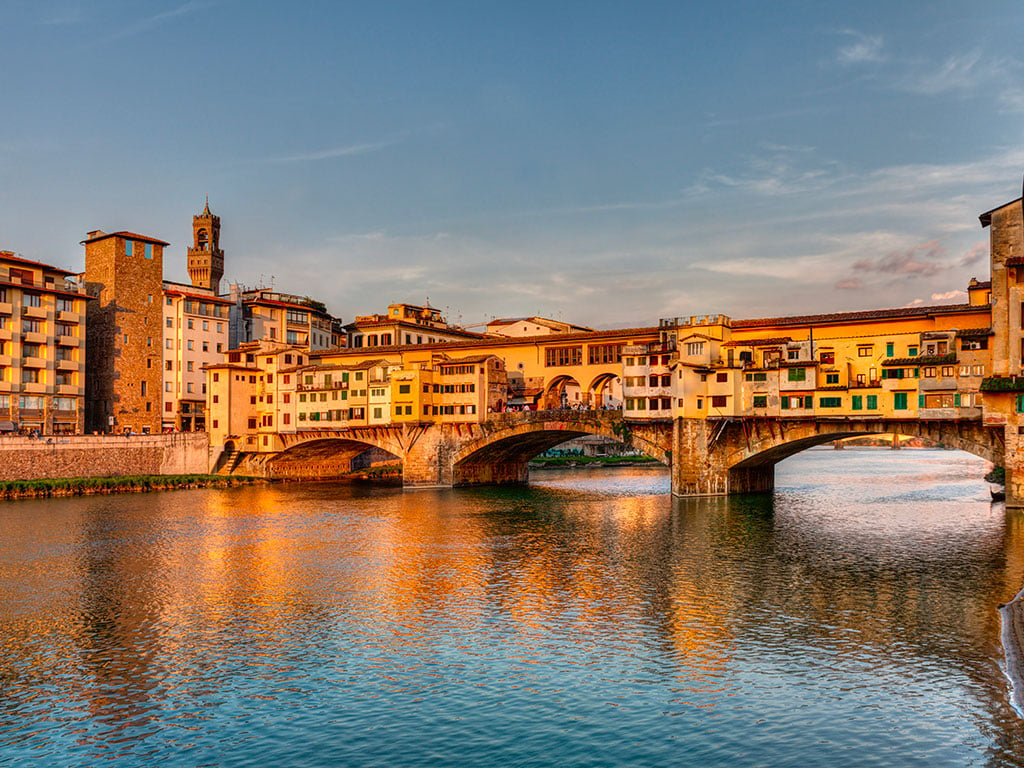
To reach the city, we recommend (if traveling by car) heading to the park-and-ride parking area in Scandicci, where you can leave your car and continue by tram to the city center (5-minute ride), stop Nenni-Torregalli. Tickets can be purchased directly from the ticket machines at the stop. For more information, visit the tramway websiteFlorence boasts an extraordinary artistic heritage. The Uffizi, the world’s most selective art gallery; the Palatine Gallery, with paintings from the “golden centuries”; the Bargello, with Renaissance sculptures; the San Marco Museum, with works by Fra Angelico; the Accademia, the Medici Chapels and Casa Buonarroti, with Michelangelo’s sculptures; the Bardini, Horne, Stibbert, Romano and Corsini Museums, the Gallery of Modern Art, the Museum of the Opera del Duomo, of Silverware and of Semi-Precious Stones.
Distinguished monuments mark the stages of Florentine artistic civilization: the Baptistery with its mosaics, the Cathedral with its sculptures, medieval churches with fresco cycles, public and private palaces – Palazzo Vecchio, Palazzo Pitti, Palazzo Medici-Riccardi, Palazzo Davanzati, the Certosa; in the Archaeological Museum a rich documentation of Etruscan civilization is preserved.
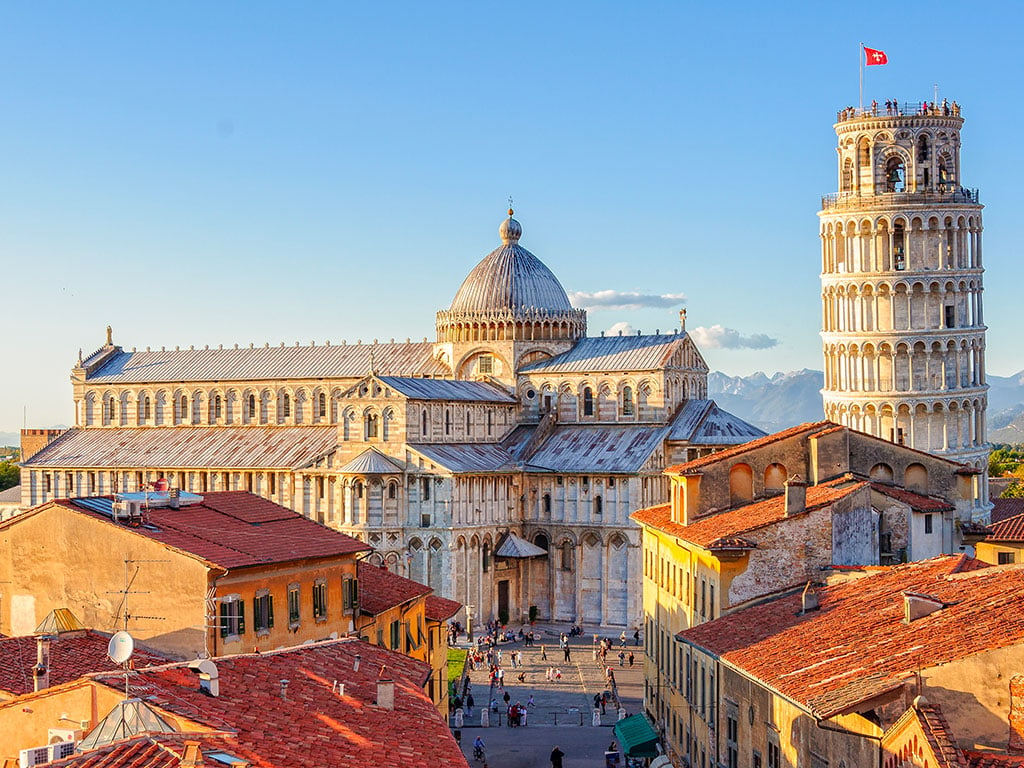
To reach Pisa we recommend traveling by car, taking the Florence–Pisa–Livorno highway (SGC Fi-Pi-Li) and exiting at Pisa Nord Est, which allows you to reach directly the parking area of Piazza dei Miracoli.
Pisa can easily be visited in half a day, leaving the remaining time for a seaside stop or a visit to Lucca, just 30 minutes away by car.
We recommend the tourist website for purchasing tickets and organizing your visit to the city.
The city of Pisa has a millennia-old history and reached its peak during the era of the Maritime Republics. Known worldwide for its “Leaning Tower”, an extraordinary monument that enhances the quadrilateral of Piazza del Duomo (Leaning Tower, Cathedral of Santa Maria Assunta, Baptistery of San Giovanni and the Monumental Camposanto), it was declared a UNESCO World Heritage Site in 1987 and was named by Gabriele D’Annunzio “Piazza dei Miracoli”.
You can also admire Piazza dei Cavalieri with the Palazzo dell’Orologio and the famous “Tower of Hunger”, the Palazzo della Carovana and the Church of Santo Stefano dei Cavalieri.
If you prefer the sea, we recommend visiting Marina di Pisa with its pleasant new marina (ideal for a walk), Tirrenia and Calambrone (sandy beaches).
The Certosa of Pisa in Calci is a vast monumental complex located at the foot of Mount Pisano, just a few kilometers from the city of Pisa. Founded in 1366 by a Carthusian family, the complex was expanded between the 17th and 18th centuries and today appears as a splendid Baroque monument.
Today the Certosa hosts two separate museums: the National Museum of the Monumental Charterhouse of Calci and the Museum of Natural History of the University of Pisa.
Visiting the first museum is an evocative journey into the world of the Carthusian monks, discovering the solitary life they led, marked by rigor, meditation and contemplation, in environments that still impress today with their splendor, magnificence and decorative richness. Beginning with the green ceremonial courtyard, continuing with the church adorned with striking frescoes, the numerous chapels for individual Mass, the monumental great cloister, the austere cell, the cloister, the large refectory for Sunday meals, the rich guest quarters for visits by the Grand Duke and the adjoining two-level cloister; finally, in a detached building, the ancient pharmacy for the production and sale of medicines.
The visiting route of the Museum of Natural History unfolds within the Certosa in the more “humble” rooms, those used by the lay monks for daily work: cellars, warehouses, oil mill, carpentry shop, hayloft and more. These spaces have been given new life by hosting the museum’s prestigious collections, the result of nearly 500 years of history. These are collections unique in historical and scientific importance, including specimens of zoology, paleontology and mineralogy, as well as live animals housed in the largest freshwater aquarium in Italy. https://www.msn.unipi.it/
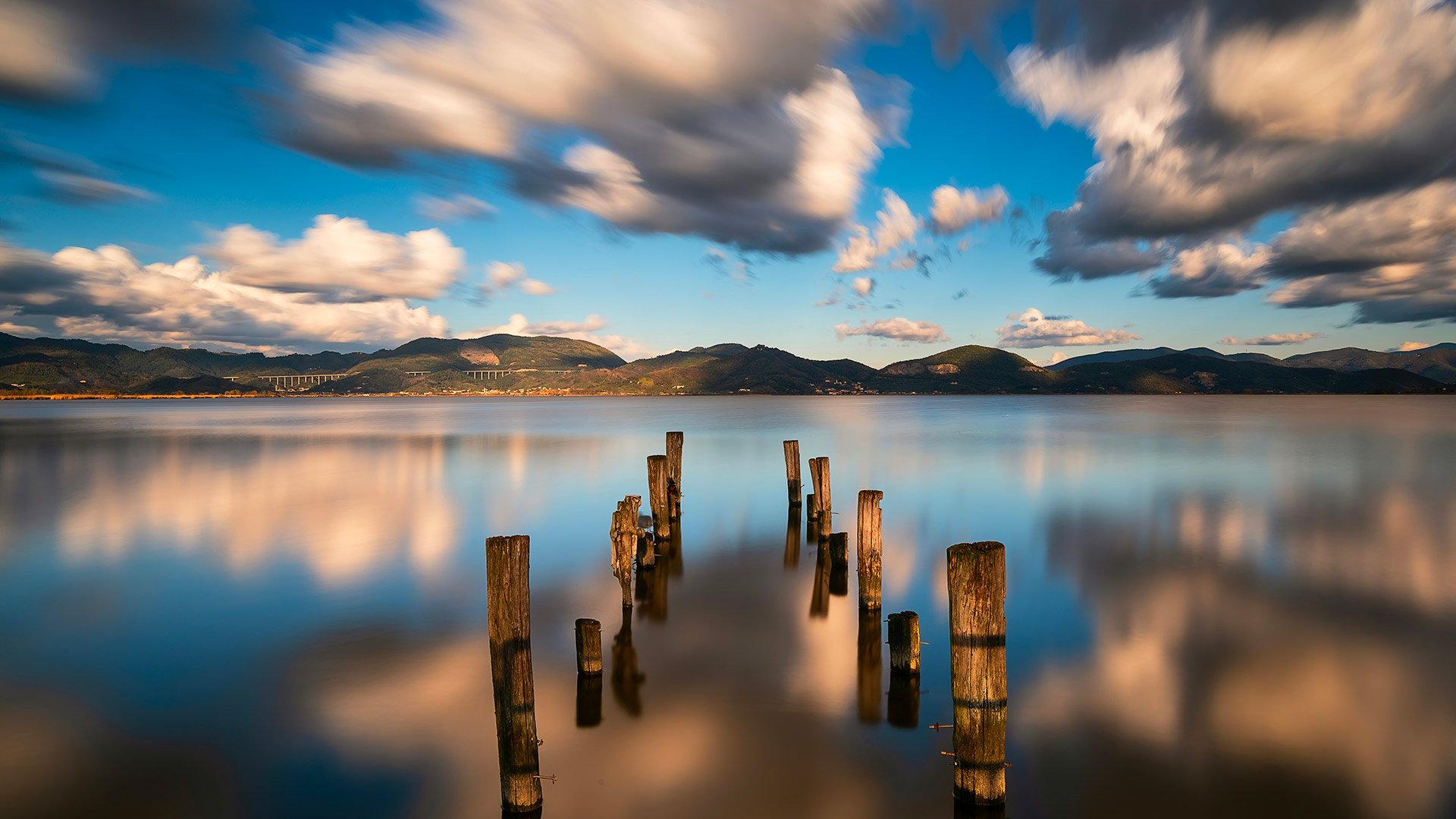
Viareggio is a beautiful town on the Tuscan coast, in Versilia, known mainly for its Carnival, the sea and the music of Puccini. A landscape that conveys peace, with mountains in the background.
Viareggio is also a place of culture, thanks to the presence of its beautiful Liberty-style villas. Many Liberty-style buildings can be admired along the promenade: the seafront avenue is the true showcase of the city. Among the most notable landmarks are the Villa Argentina and Caffè Margherita – almost unchanged since the time it was frequented by Giacomo Puccini.
The city was built by Buontalenti in 1577, as the Medici wanted to secure access to the sea.
Art lovers are advised to visit Villa Mimbelli, home to the Civic Museum Fattori where, in addition to the painter’s works, numerous masterpieces by the Tuscan Macchiaioli are displayed.
Another must-see destination is Terrazza Mascagni, famous for its checkerboard mosaic pavement and its balustrade of 4,100 marble columns, overlooking the sea.
The entire coastline south of Livorno, accessible via the SS1 Aurelia road, is characterized by numerous coves and cliffs offering panoramic sea views.
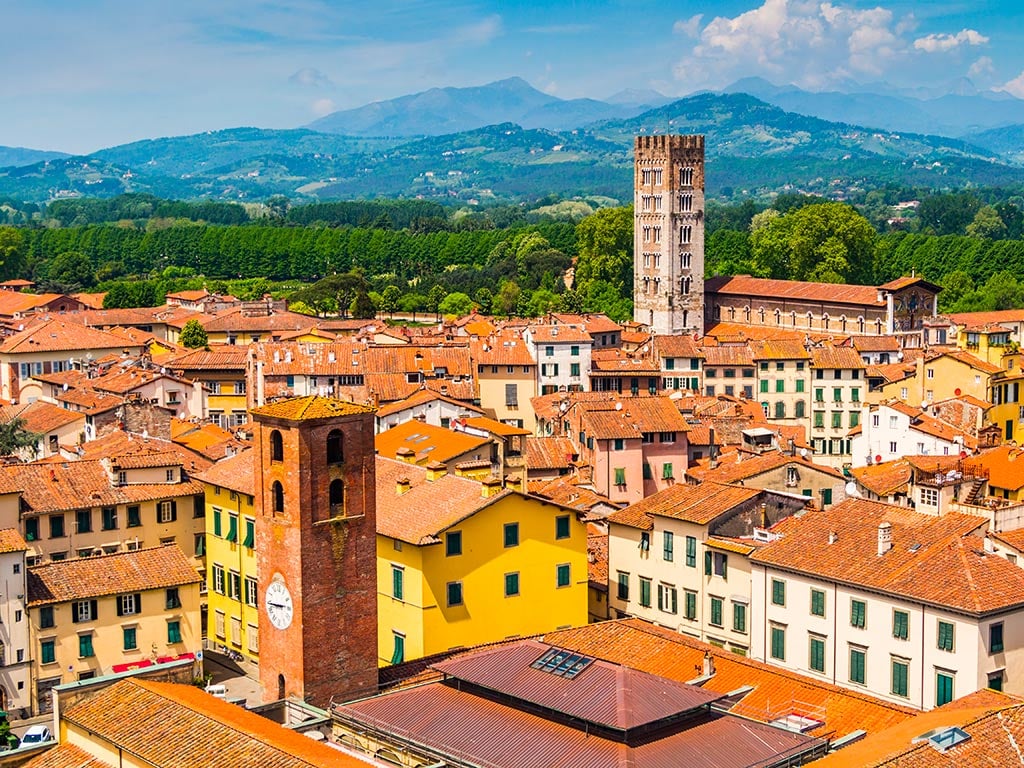
The best way to visit Lucca is from above: by walking the circular route along the city walls, climbing the Guinigi Tower or ascending the 207 steps of the even taller Torre delle Ore. From these points you can admire a splendid panorama over the rooftops of the Tuscan town.
We recommend renting a bicycle or tandem (along the walls you will find many shops for bike rental) to ride along the walls.
Piazza dell’Anfiteatro reveals in its name what once stood in the space now occupied by one of Italy’s most beautiful squares. The Church of San Michele, also known as Foro, stands on the site of ancient Lucca’s center. The two main axes, Via Fillungo and Via San Paolino, now streets for shopping and social life, follow the ancient Roman decumani. Also worth visiting are the Cathedral of Lucca, the Church of San Frediano and the National Museum of Villa Mansi.
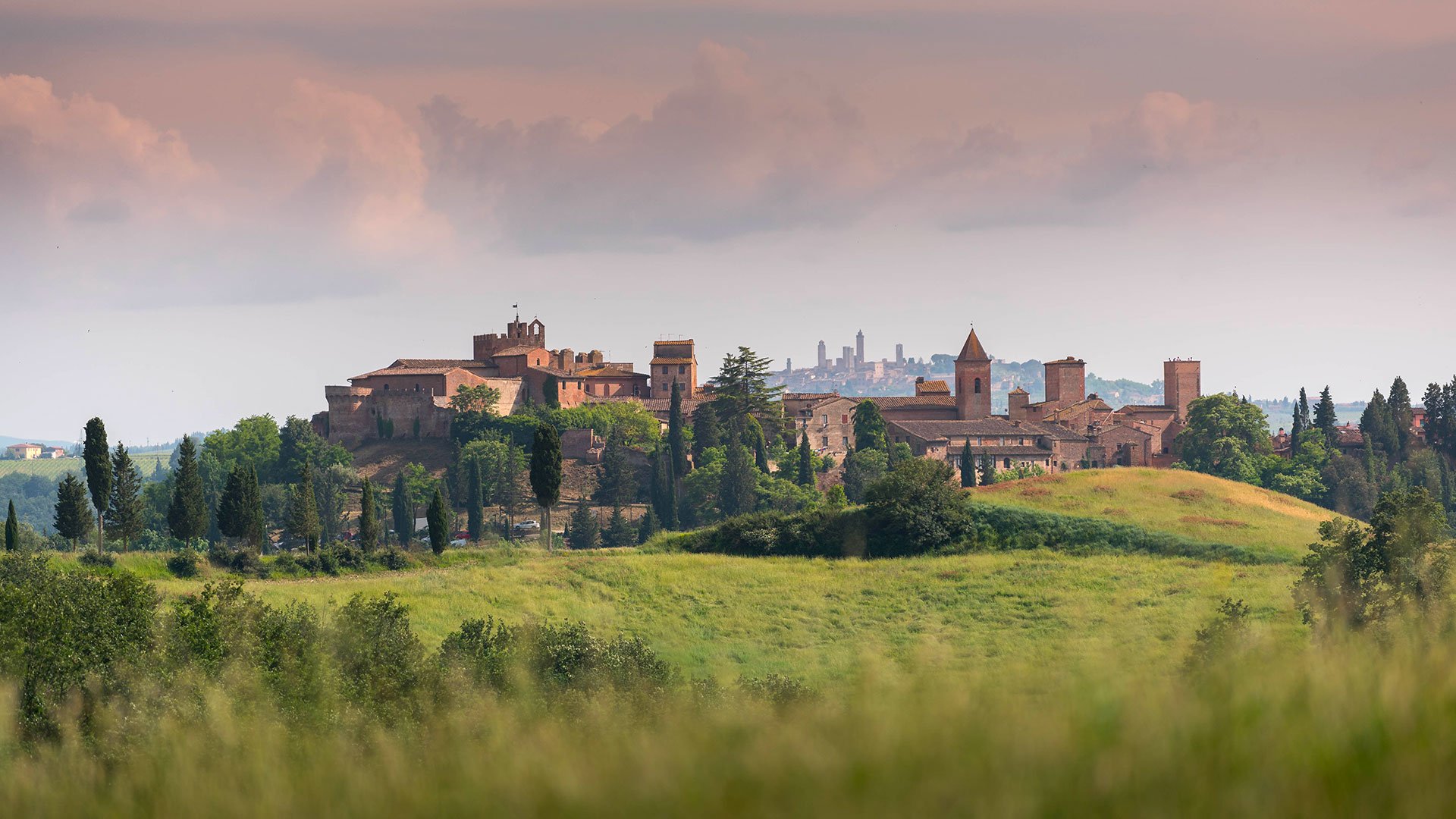
The medieval village is one of the most evocative in the Tuscan countryside, known and loved not only for its aesthetic and architectural uniqueness but also as the birthplace of Giovanni Boccaccio.
Certaldo Alto preserves perfectly its medieval urban layout, with narrow streets and small scattered squares (excluding the renovations of Palazzo Pretorio in the 15th century).
Further evidence of this characteristic is the absence of a large square in the historic center, replaced instead by a long and wide street (Via Boccaccio).
San Gimignano certainly ranks among the most famous and well-known medieval villages in Tuscany; calling it a ‘pearl’ hardly does justice to its beauty and poetry.
Due to the distinctive medieval architecture of its historic center, it has been declared a UNESCO World Heritage Site.
San Gimignano is especially famous for its approximately sixteen medieval towers, which earned it the nickname “Manhattan of the Middle Ages.” Torre del Podestà, known as La Rognosa, stands 51 meters high, while the tallest is Torre Grossa at 54 meters.
Not to be missed is the detailed and well-stocked ‘Museum of Torture’.
The city, famous for the extraction and craftsmanship of alabaster, preserves a remarkable historic center of Etruscan origin with Roman ruins and medieval buildings such as the Cathedral and Palazzo dei Priori in the square of the same name.
Of particular interest: the Romanesque-style Cathedral, the Baptistery of San Giovanni, built in the second half of the 13th century. Palazzo dei Priori: located in Piazza dei Priori and built in 1246.
The Medici Fortress: composed of two fortifications connected by a curtain wall. The older fortress features a semi-elliptical tower. The Roman Amphitheater was brought to light in the 1950s through archaeological excavations carried out in the Vallebuona area.
To reach it, we recommend taking State Road 429 leading to Poggibonsi via Certaldo Alto. In Poggibonsi you will find the entrance to the toll-free Florence–Siena highway. Before reaching the Siena Nord exit, while traveling on the Florence–Siena highway, you will encounter the Monteriggioni exit, which allows you to visit the homonymous splendid medieval village.
Siena is a place rich in history and art, as well as strong traditions, mainly linked to the districts and the famous Palio di Siena.
In the heart of the city lies the wonderful Piazza del Campo, one of Siena’s symbolic places, where the famous Palio takes place.
In the square you can admire the Fonte Gaia, the Palazzo Comunale and the Torre del Mangia.
The Museo dell’Opera del Duomo is one of the oldest private museums.
Monteriggioni represents one of the most significant fortified villages in the area. It has remained intact, as if time had never passed.
The castle was built in the 13th century by the Republic of Siena, with the primary purpose of defending Siena from its rival Florence. For centuries, the settlement fully fulfilled its role, repelling countless sieges and attacks. Its military function declined from the mid-16th century, when the entire territory of Siena was annexed to Florence.
Piazza del Duomo is the heart of the city and home to its most important monuments: Palazzo Pretorio, the Baptistery and the Cathedral of San Zeno.
Palazzo Pretorio was the seat of the city court and preserves frescoes and centuries of Pistoia’s history; the Baptistery of San Giovanni in Corte is an octagonal building made of white Carrara marble and green Prato marble; the Cathedral of San Zeno is a marvel of Romanesque art, with architectural and pictorial layers from later periods.
The symbol of Montecatini is its thermal park, rich in spa buildings, including the Tettuccio, the city’s most important thermal structure due to its noble architecture.
Montecatini Alto is a very ancient small village, with origins dating back before the year 1000. It can be reached by the funicular, highly evocative and definitely worth visiting.
The funicular was built at the end of the 19th century and still preserves its original wooden interiors and early 20th-century floral style.
One of the first things that catches the eye within the city is the Castello dell'Imperatore: the only historical example of Swabian architecture in central-northern Italy. Nearby is Piazza Duomo which hosts the Cathedral of Santo Stefano.
We recommend visiting the Textile Museum which bears witness to the city’s rich textile history; the building that houses the museum is the “Cimatoria Campolmi Leopoldo e C.”, a large 19th-century factory located within the city.